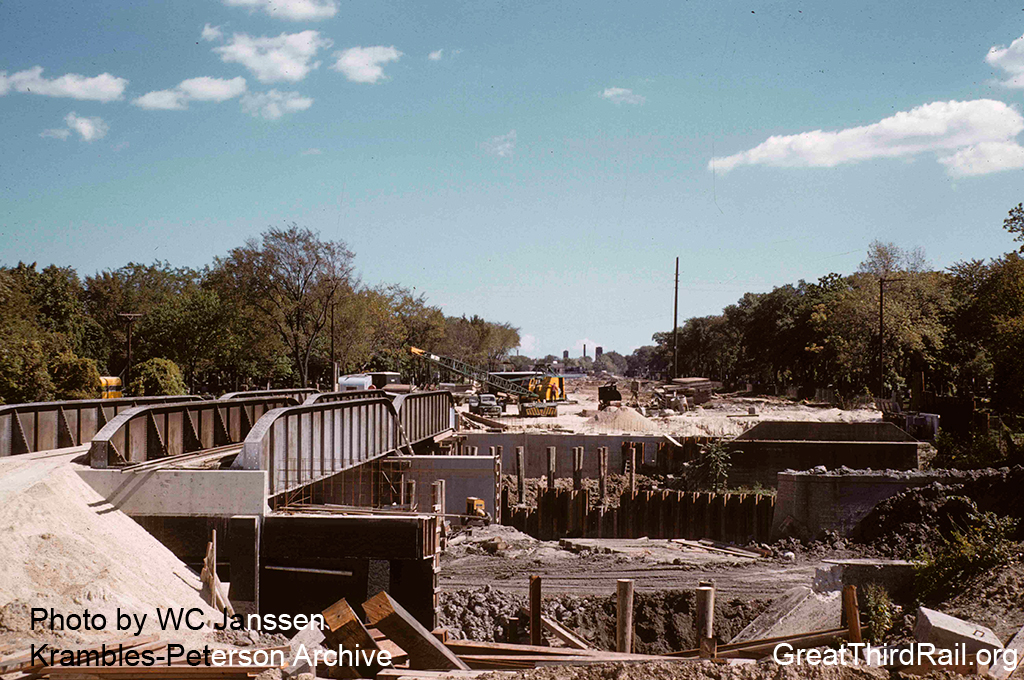
Main Line
- Date of Opening: August 25, 1902
- Date of Abandonment:
- Passenger: July 3, 1957
- Freight: June 10, 1959
- Total: July 6, 1961
- Length of Route: 15.6 miles
- Total Number of Stations: 24
- Number of Tracks: 2
- Type of Traction: Third rail
The Great Third Rail’s Main Line was its highly used double track line between Forest Park and Wheaton. (The Main Line technically continued from Forest Park east to Laramie Avenue in Chicago since the Aurora & Elgin owned this section of track and provided service to all of the local stations there between 1902 and 1905. For the purposes of this profile that section is considered to be a poition of the Garfield Park Branch.)
Route
From Forest Park the line traveled west, squeezing into a small strip of land between Concordia and Waldheim Cemeteries before entering Maywood. Starting near 11th Avenue in Maywood, the line began running alongside the tracks of the Chicago Great Western as it passed through the villages and cities of Bellwood, Hillside, Berkeley, and Elmhurst until reaching Villa Park. Shortly after entering Villa Park the Chicago Great Western took a slight bend in its route to the north and the two roads diverged: the Great Western heading northwest and the Aurora & Elgin continuing on to the west. The line continued on through Villa Park, passing through Lombard and on into Glen Ellyn. Once in Glen Ellyn, it met up with the Chicago & Northwestern (known today as Metra’s Union Pacific West Line). Like it did with the Chicago Great Western, the Main Line began directly paralleling the Chicago & Northwestern and followed it out to Wheaton.
History
Construction began in September 1900 and was finished by mid 1902. Initially the date set for the start of service was July 1, 1902, but this kept getting pushed back for various reasons. Service finally started on August 25, 1902, with all trains operating as locals between Aurora and 52nd Avenue in Chicago. (52nd Ave. would later come to be known as Laramie Ave.)
Service was modified slightly with the opening of the Elgin Branch in 1903. Trains now departed Chicago every fifteen minutes with trains alternating between those bound for Aurora and those bound for Elgin, providing communities along the Main Line twice as frequent service as those along the branches.
In 1906 the AE&C opened up a new branch, however this time it wasn’t a new extension from Wheaton or from the branches to Aurora or Elgin. It branched off from Bellwood. This new branch was single track line built to serve the Oak Ridge and Mt. Carmel Cemeteries in Hillside. The opening of the Mt. Carmel branch had little impact on general operations on the Main Line. It was served by a shuttle car that ended at a stub track at the Bellwood station.
It lasted as a passenger service until 1926 with the opening of the Westchester branch which also branched off at Bellwood Avenue. Because of the close proximity of the two services, shuttle passenger service on the Mt. Carmel Branch was ended. But more than this, the opening of the Westchester branch had a definite impact on operations over the Main Line.
Unlike any of the other branches, the Aurora & Elgin never provided service over the new branch. Instead, service was provided by the Chicago Rapid Transit Company (CRT). Yet to reach the branch, which started all the way out at Bellwood Avenue, the CRT would have to operate over a portion of the Main Line. And on top of that, the new Westchester rapid transit service also called for operating local service at the stations between Bellwood and Forest Park on the Main Line, allowing Aurora & Elgin trains shorter running time.
But the Westchester operation was but one benefit that the Main Line received. Over the years the line was changed, bit by bit. The reballasting of the entire line, installation of block signals, and grade separation of the Indiana Harbor Belt crossing are examples of just some of these changes.
But beyond physical improvements, the line also began to change its character as the area surrounding it changed. As open prairie converted into a suburban landscape, stations were added and the schedules were altered. The line began to shift from the revolutionary high-speed interurban that it was when it first opened to more of a commuter railroad.
And while things were good for the Great Third Rail while the Rapid Transit provided service to Westchester, the Chicago Transit Authority (who had taken over operations of the CRT) decided to end the service in 1951. The Aurora & Elgin once again began making local stops between Bellwood and Forest Park.
Yet the end was already in sight. Construction of the Congress Street Superhighway [Eisenhower Expressway] forced the rerouting of the Garfield Park “L” in 1953 and the Aurora & Elgin began terminating their trains at Forest Park. Passenger service came to an end on July 3, 1957 at 12:13 p.m., and freight followed a little while later, ending on June 10, 1959. For a time the Main Line remained with nothing operating, but in 1961 the railroad was completely abandoned.